June Petrie
'Salem's Lot: A NovelJune Petrie is the mother of Mark Petrie and the wife of Henry Petrie. She appears within the Petrie family’s orderly domestic world, a household shaped by Henry’s confidence in rational explanation and by Mark’s unusual interest in monsters, death, and the supernatural. June’s importance is concentrated in the family’s response to the crisis surrounding Mark: she senses that her son has changed, fears the shadow cast by the deaths of Ralphie Glick and Danny Glick, and becomes one of the immediate victims of Kurt Barlow’s assault on the family.
Identity and Family Setting
June is presented primarily through her place in the Petrie household. She and Henry eat sandwiches in their kitchen while attempting to understand a telephone call from Father Callahan, who reports that Mark is with him and will soon be brought home. The couple considers contacting Parkins Gillespie but decides to wait, an act that places the family between ordinary civic procedure and an emergency they do not yet understand. June’s concern is sharpened by her recognition that Mark, whom she regards as unusually perceptive, has undergone some kind of change. The deaths of Ralphie Glick and Danny Glick remain an unspoken presence over the meal, making domestic silence itself part of the family’s fear.
June’s family life is contrasted with Henry’s intellectual self-possession. Henry is highly educated, professionally ambitious, and committed to the explanatory order of physics, mathematics, economics, and sociology. His confidence is not portrayed as a lack of love: his attachment to June and Mark is described as sturdy and unswerving, even though it is expressed through habitual order rather than sentimentality. June’s agitation therefore registers the emotional pressure that Henry’s rational framework attempts to contain. When she grows increasingly distressed while Henry listens to Mark and Father Callahan, her response becomes the visible measure of how unbearable their story is becoming.
The Petrie Household Under Threat
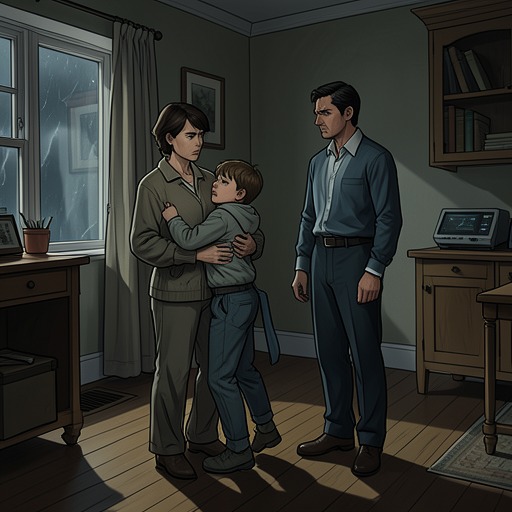
The family’s crisis begins in conversation. Henry listens to Mark’s account and to Father Callahan’s corroborating testimony, asking clear questions whenever the narrative becomes confused. June listens as well, but unlike Henry she does not convert the grotesque material into an intellectual problem. Henry’s verdict is that the account is “Impossible.” When June begins to challenge or interrupt him, he raises a hand and stops her almost casually, then she sits down and pulls Mark slightly away from Father Callahan. The gesture reveals both her anxiety and her immediate physical instinct to keep her child close.
That protective movement becomes crucial when the attack begins. The telephone has stopped working, the lights go out, and the kitchen is thrown into darkness. June screams as the family stumbles about, calling to one another; within roughly thirty seconds, the window over the sink crashes inward, scattering glass across the counter and linoleum. The supernatural invasion therefore tears through the most ordinary details of family life: a kitchen, a telephone, electric lights, and a shared evening conversation. June’s fear is not abstract. It is a bodily reaction to a household suddenly stripped of the conditions that made it feel safe.
Barlow’s Attack and June’s Death
Father Callahan’s cross briefly illuminates the room, exposing the intruder behind Henry: Barlow, with a white, grinning face, long sharp fangs, and lurid red eyes. Mark is trying to pull June toward the archway leading into the living room, placing her within the child’s desperate attempt to move his mother out of danger. Before that effort can succeed, Barlow seizes Henry’s head in one hand and June’s in the other. He brings their heads together with a fatal crack, and both parents collapse immediately.
June’s death is thus part of Barlow’s deliberate fulfillment of a threat against the Petrie family. It is not an accidental consequence of the attack or an isolated act of feeding; it is a demonstration of power directed at Mark’s parents before Barlow captures Mark himself. The violence also destroys the family’s previous division between rational adult authority and frightened childhood perception. Henry’s calm denial cannot protect them, and June’s instinct to shelter Mark cannot overcome Barlow’s physical force. The mother who had tried to draw her son away is killed at the very moment the family’s private world is breached.
Relationship with Mark and Narrative Role
June’s relationship with Mark is conveyed through proximity and protection rather than extended dialogue. She recognizes that he is a “Deep One,” an expression of her awareness that his imagination and perception differ from those of ordinary children. Yet the narrative does not reduce her concern to indulgence or eccentricity. The specters of the Glick children make her apprehension intelligible: Mark’s changed behavior is occurring in a town where children have already disappeared or died under mysterious circumstances.
Her final action is instinctive rather than strategic. When danger enters the kitchen, Mark attempts to drag her toward safety, while June’s earlier gesture had drawn him toward her side. The movement between mother and son forms a compact emotional pattern: each tries to protect the other, but neither can stop the attack. After June’s death, Mark is no longer merely a child whose unusual knowledge worries his parents. He becomes a surviving witness and an active participant in the struggle against Barlow. June’s loss is therefore one of the forces that converts Mark’s private fear into public resistance.
Change and Significance
June begins as a mother confronting disturbing evidence within the familiar rituals of supper, family conversation, and concern over a son’s behavior. She ends as a casualty of the supernatural occupation of Jerusalem’s Lot, killed in her own kitchen alongside Henry. Her trajectory is short, but its reversal is decisive: the home that should protect the family becomes the site of its destruction, and the adults who might be expected to defend the child are rendered helpless almost instantly.
June’s narrative significance lies in this collision between maternal care, adult disbelief, and supernatural violence. Her presence makes the Petrie family’s destruction intimate rather than merely strategic. Barlow does not attack an anonymous household; he breaks into a family already trying to understand what has happened to its son, kills both parents in front of him, and leaves Mark to carry knowledge that the adults could not accept in time. Through June, the novel shows how the vampire threat enters not only public spaces but also the emotional architecture of home, turning protection, reason, and family closeness into fragile defenses.